

Indian Astronomy & Vedic Sky Science: What if Earth Stopped Moving?
Introduction — why the sky is not what it seems
Nothing in the cosmos is still. The solar system is a vast orchestra: every planet moves in its own rhythm, Earth rotates relentlessly around the Sun, the Moon traces its slow orbit, and distant stars burn silently in the background. It is a cosmic poem written in the language of motion.
But imagine this: what if we could stop Earth entirely — no rotation, no orbit? Would the sky look the same? Would the dance of planets and stars continue unchanged? This question is not only scientific; it is philosophical. It forces us to ask what "real" actually means when we look up at night.
The Solar System and Earth–Moon relationship
At the centre of our solar system lies the Sun — a sphere of immense energy whose gravity holds eight planets, dozens of moons and countless particles of dust. Earth completes one orbit of the Sun in roughly 365 days, 5 hours, 48 minutes — what we call the tropical year. The Moon, our closest celestial companion, orbits Earth once every 27.3 days, but the interval from one full moon to the next is about 29.5 days — the synodic month.
What if Earth were stationary? — the Geocentric Model
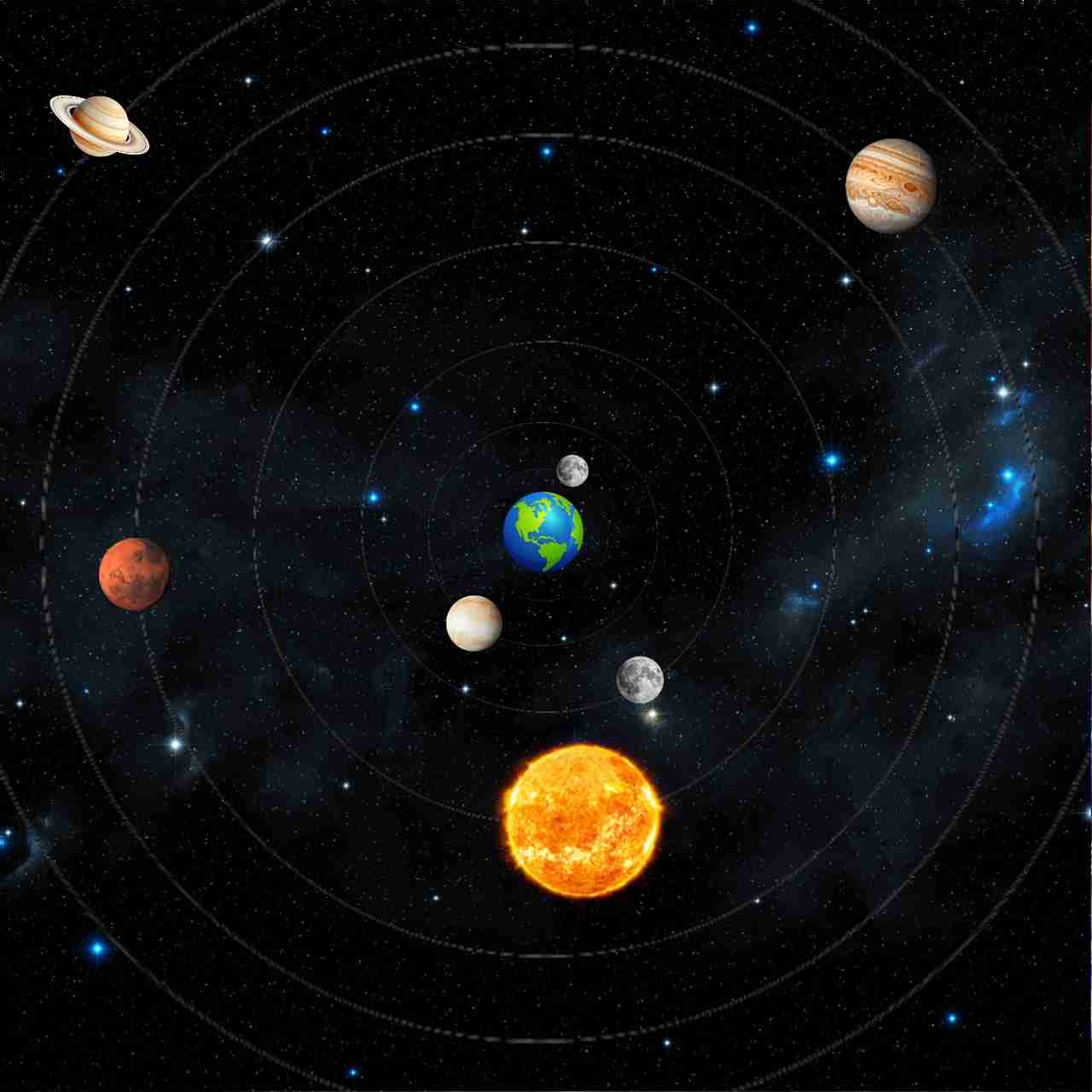
If we treat Earth as the fixed centre, the Sun, Moon and stars appear to revolve around us daily. This is precisely how ancient Indian astronomers described the sky — through a geocentric model recorded in the Surya Siddhanta and Aryabhatiya, where the Sun rises in the east and sets in the west every day.
Modern science tells us that it is Earth that moves — but philosophically, the distinction reminds us that "perception" and "reality" are not always the same thing.
The Sky as Seen from a Stationary Earth — Geocentric Model, Apparent Motion & Retrograde
The Geocentric Model
For most of human history, the most popular description of the cosmos was the Geocentric Model — Earth at the centre, with the Sun, Moon, planets and stars revolving around it.
The model is described in remarkable detail in Claudius Ptolemy's Almagest. Indian astronomical texts, especially the Surya Siddhanta and Aryabhatiya, contain closely parallel descriptions of a geocentric sky.
Apparent Motion
The motion we see when we look at the sky is apparent motion — not real motion, but motion as perceived by an observer.
Everyday example: If you sit in a moving train and watch the fields outside, the trees appear to move backwards. In reality the trees are still — you are the one moving forward.
Retrograde Motion — when a planet appears to move backwards
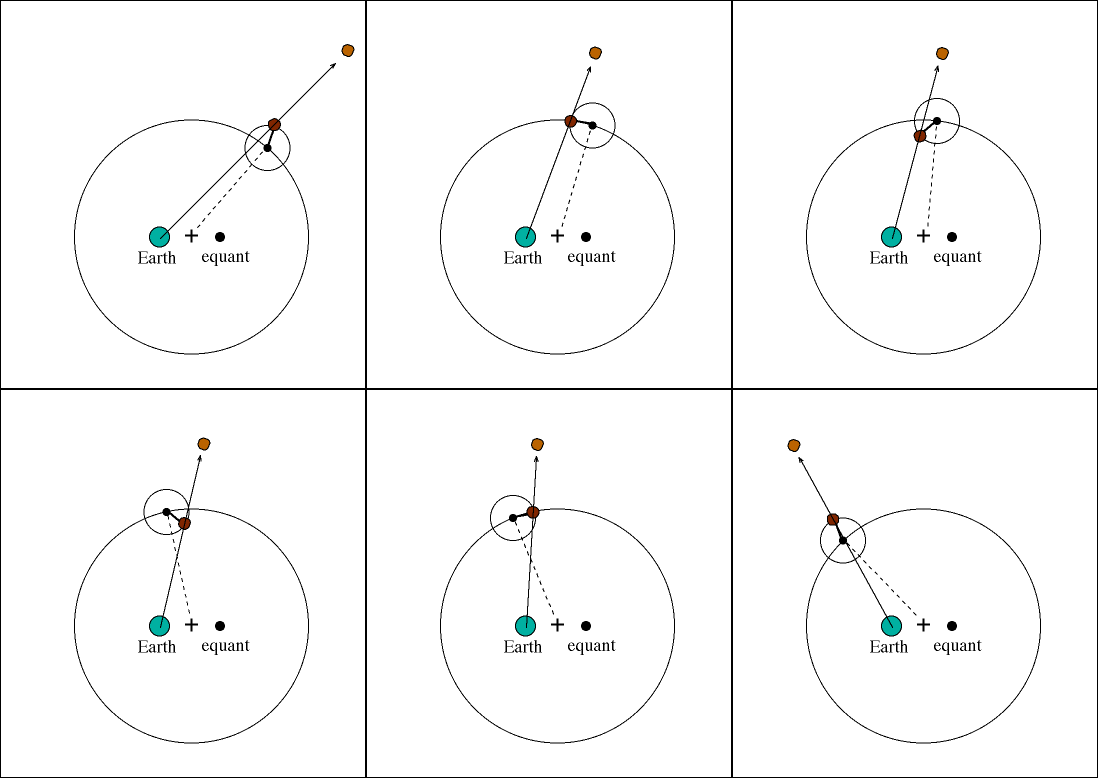
The most puzzling phenomenon is retrograde motion — a planet seeming to reverse direction for days or weeks. It is most visible for the outer planets: Mars, Jupiter and Saturn.
The geocentric model explained this using epicycles (small circles) rolling on deferents (larger circles).
Analogy: Imagine running on a track and overtaking a slower runner in the adjacent lane. As you pass, that runner appears to move backwards — that is exactly what outer-planet retrograde looks like from Earth.
Source: NASA and ISRO solar-system visualisations.
Heliocentric vs Geocentric — Two Ways of Computing the Sky
1. Fundamental idea
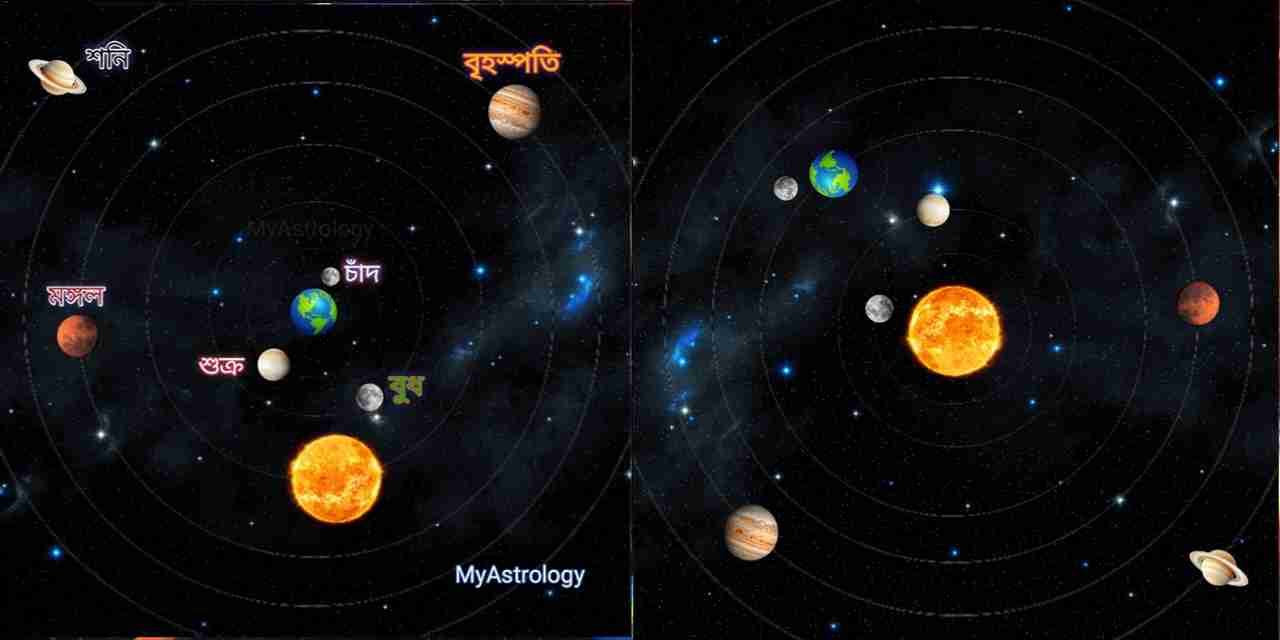
Heliocentric Model: In 1543 Nicolaus Copernicus proposed in De revolutionibus orbium coelestium that the Sun — not Earth — lies at the centre of the solar system, and that all planets, including Earth, orbit it.
Geocentric Model: Popular in ancient Greece and India, this model treats Earth as stationary and describes the Sun, Moon and planets as revolving around it.
2. Time and motion
In the geocentric model, planetary motion requires epicycles and deferents.
In the heliocentric model, motion is described by simple elliptical orbits governed by Kepler's three laws:
- Orbits are ellipses
- Equal areas are swept in equal times
- The square of the orbital period is proportional to the cube of the semi-major axis: T² ∝ R³
3. Which one is scientifically correct?
Modern astronomy — including all ISRO and NASA research — rests on the heliocentric model. Satellite trajectories, space probes and interplanetary missions can only be computed with heliocentric mechanics.
4. Comparison table
| Subject | Geocentric Model | Heliocentric Model |
|---|---|---|
| Centre | Earth | Sun |
| Complexity | High (needs epicycles) | Low (Kepler's laws suffice) |
| Accuracy | Limited (visual only) | High (mathematical + observational) |
| Observation | Directly visible | Requires telescope/model |
| Modern use | None | All space research and missions |
| Proponents | Ptolemy, Surya Siddhanta | Copernicus, Kepler, Galileo |
Sources: Copernicus (1543) — De revolutionibus orbium coelestium; Claudius Ptolemy — Almagest; ISRO & NASA Solar System Graphics.
Orbital Periods of the Planets (Heliocentric)
1. What is a heliocentric period?
Imagine standing on the Sun. Around you, Mercury, Venus, Earth, Mars, Jupiter and the rest move along their own paths.
A heliocentric period is the time a planet takes to complete one full circuit of the Sun.
2. Kepler's Third Law in plain language
Four hundred years ago, Johannes Kepler observed that the farther a planet is from the Sun, the longer it takes to orbit it.
His third law:
T² ∝ R³
- T = orbital period (in Earth years)
- R = mean distance from the Sun (in AU)
- 1 AU = mean Earth–Sun distance ≈ 149.6 million km
Worked example — Mars:
Earth → R = 1 AU, T = 1 year | Mars → R = 1.524 AU
- R³ = 1.524³ ≈ 3.54
- Normalising with Earth's values (1 AU → 1 year), T² = 3.54 ⇒ T = √3.54 ≈ 1.88 years
So Mars takes roughly 1 year and 11 months to complete one orbit of the Sun.
3. NASA Planetary Fact Sheet — orbital periods
| Planet | Distance (AU) | Orbital period (years) | Days |
|---|---|---|---|
| Mercury | 0.387 | 0.241 | 88 |
| Venus | 0.723 | 0.615 | 225 |
| Earth | 1.000 | 1.000 | 365 |
| Mars | 1.524 | 1.88 | 687 |
| Jupiter | 5.203 | 11.86 | 4,332 |
| Saturn | 9.537 | 29.46 | 10,759 |
| Uranus | 19.191 | 84.01 | 30,687 |
| Neptune | 30.07 | 164.8 | 60,190 |
4. Shape of the orbits
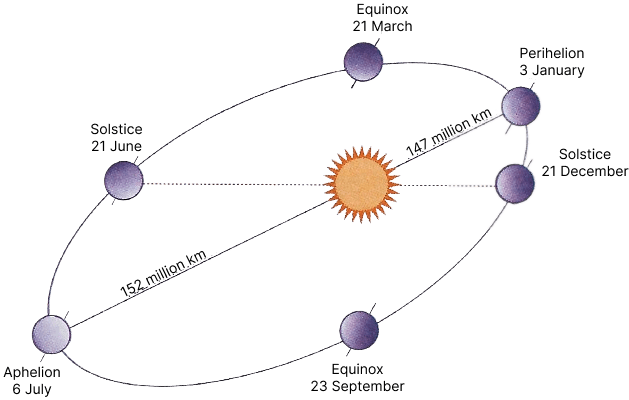
All planets move along elliptical orbits, with the Sun at one focus.
- Perihelion (closest to the Sun) → the planet moves faster
- Aphelion (farthest) → the planet moves slower
Sources: Johannes Kepler — Harmonices Mundi (1619); NASA Solar System Exploration; ISRO Space Science Data.
Synodic Period — Planetary Motion as Seen from Earth
1. What is a synodic period?
Imagine watching a planet from the ground. The synodic period is the time it takes for a planet to return to the same position relative to Earth and Sun — for example, from one opposition to the next.
- Heliocentric period → how long the planet takes to orbit the Sun
- Synodic period → how long before the same configuration is visible from Earth
2. Worked example — Mars
Heliocentric period (Tₘ) = 1.88 years · Earth's period (Tₑ) = 1 year
1/S = | (1/Tₑ) − (1/Tₘ) | (outer planets)
- 1/Tₑ = 1
- 1/Tₘ = 1 / 1.88 ≈ 0.532
- Difference = 1 − 0.532 = 0.468
- S = 1 / 0.468 ≈ 2.136 years
So Mars takes roughly 2 years and 50 days to return to the same configuration as seen from Earth.
3. Inner planets — different formula
For inner planets (Mercury, Venus), the two periods add instead of subtract:
1/S = (1/Tₑ) + (1/Tₘ) (inner planets)
4. Synodic periods table
| Planet | Heliocentric period (years) | Synodic period (days) |
|---|---|---|
| Mercury | 0.241 | 116 |
| Venus | 0.615 | 584 |
| Mars | 1.88 | 780 |
| Jupiter | 11.86 | 399 |
| Saturn | 29.46 | 378 |
| Uranus | 84.01 | 370 |
| Neptune | 164.8 | 368 |
5. Application in Vedic astrology
- Sidereal positions matter for predicting planetary transits (gochar).
- Tithi, nakshatra, yoga and karana in the daily Panchang rely on geocentric positions.
- Saturn stays in one sign for about 2.5 years — accurate sidereal positions are essential for computing "Sade Sati".
Sources: ISRO, US Naval Observatory, NASA Solar System Dynamics.
♈ The Zodiac and Planetary Transits
1. What is the zodiac?
The zodiac is an imaginary 360° circle in the sky, divided into twelve equal segments of 30° each. Each segment is a rashi (sign), from Aries ♈ to Pisces ♓.
The Sun, Moon and planets all move along this circle — which we call the ecliptic (Ecliptic).
2. Sidereal vs Synodic period
| Term | Meaning | Reference | Example |
|---|---|---|---|
| Sidereal period | Time to orbit once relative to the fixed stars | Star frame | Mars: 687 days |
| Synodic period | Time to return to the same configuration from Earth | Earth + planet | Mars: 780 days |
3. Time taken to cross the zodiac
| Body | Sidereal period (days) | Time per sign | Full zodiac |
|---|---|---|---|
| Moon 🌙 | 27.3 | ~2.25 days | 27.3 days |
| Mercury ☿ | 88 | ~7.33 days | 88 days |
| Venus ♀ | 225 | ~18.75 days | 225 days |
| Sun ☀ | 365.25 | ~30.44 days | 365.25 days |
| Mars ♂ | 687 | ~57.25 days | 687 days |
| Jupiter ♃ | 4333 | ~361 days | 12 years |
| Saturn ♄ | 10759 | ~898 days | 29.46 years |
Sources: ISRO, US Naval Observatory.
★ Vedic vs Western Astronomy — Two Skies, One Sky
Readers coming from a Western background often ask why the sign they see in an Indian horoscope differs from the one in a Western sun-sign column. The answer is not interpretive — it is astronomical.
The ayanamsa — why the signs differ
Earth's axis precesses like a slowly wobbling top. Over approximately 25,800 years, the point of the vernal equinox drifts westward through the zodiac. The offset between the tropical zodiac (fixed to the vernal equinox, used in Western astrology) and the sidereal zodiac (fixed to the stars, used in Vedic astrology) is called the ayanamsa.
In the 21st century, the ayanamsa is roughly 24 degrees — which means most people have a Western sun sign and an Indian rashi separated by one full sign.
Comparison
| Aspect | Vedic / Indian astronomy | Western astronomy |
|---|---|---|
| Zodiac reference | Sidereal — fixed to stars | Tropical — fixed to vernal equinox |
| Ayanamsa correction | Yes (Lahiri / Chitrapaksha) | No |
| Primary texts | Surya Siddhanta, Aryabhatiya, Pancha Siddhantika | Almagest, De revolutionibus, Principia |
| Calendar base | Lunisolar — tithi-based months | Solar — Gregorian months |
| Subdivisions | 27 nakshatra of 13°20′ each | 12 signs of 30° each |
| Primary use today | Panchang, muhurta, Jyotish | Observational astronomy, space science |
Which one should you use?
Both are correct — for different purposes. Tropical coordinates are the language of modern astronomy and spaceflight. Sidereal coordinates are the language of the Indian calendar and Vedic astrology. When a Panchang says "Sun enters Karka (Cancer) on 16 July", it means the sidereal entry — the actual moment the Sun crosses the sidereal boundary, not the tropical one.
At MyAstrology, every chart is computed sidereally using the Lahiri ayanamsa, consistent with the Indian Calendar Reform Committee (1955) and the classical texts of Jyotish.
Tropical Year vs Lunar Year
1. The tropical year (solar year)
The tropical year is the time Earth takes to complete one orbit of the Sun, measured against the vernal equinox.
- Duration: 365 days, 5 hours, 48 minutes, 46 seconds
- In decimal days: 365.2422 days
- The Gregorian calendar approximates this value.
2. The lunar year
The lunar year is twelve full lunations — from new moon to new moon, twelve times over.
- Average synodic month: 29 days, 12 hours, 44 minutes, 3 seconds
- Twelve months: ≈ 354.36 days
So the lunar year is about 10 days and 21 hours shorter than the tropical year.
3. Difference at a glance
| Year type | Days | Hours | Minutes | Seconds | Difference |
|---|---|---|---|---|---|
| Tropical year | 365 | 5 | 48 | 46 | — |
| Lunar year | 354 | 8 | 48 | 36 | ~10 d 21 h shorter |
4. Astronomical reason
- The tropical year depends on Earth's orbit around the Sun (see tropical year).
- The lunar year depends on the Moon's orbit of Earth (see orbit of the Moon) and its changing angle relative to the Sun.
5. The role of Adhika Masa (Mala Masa)
Because the lunar year is shorter than the tropical year, the Hindu calendar adds an extra month — Adhika Masa, also called Mala Masa or Purushottama Masa — approximately once every 32–33 months. This keeps festivals and seasons aligned — which is why Durga Puja always falls in autumn, even though its Gregorian date shifts from year to year.
Tithi and Why Hindu Festival Dates Shift
1. What is a tithi?
A tithi is the time taken for the angular separation between the Moon and the Sun to increase by 12°.
- One full lunation contains 30 tithi — 15 waxing (Shukla Paksha) and 15 waning (Krishna Paksha).
- Individual tithi vary in length from 23 hours 37 minutes to 25 hours.
- Because a tithi rarely maps neatly onto sunrise-to-sunrise days, festival dates shift in the Gregorian calendar year after year.
2. Why tithi varies
- The Moon's orbit is elliptical, so its angular speed varies.
- Earth's own orbital motion means the relative Sun–Moon geometry changes unevenly from day to day.
- This is why Durga Puja, Diwali and Janmashtami fall on different Gregorian dates each year.
3. The Hindu calendar
The Hindu calendar is lunisolar — it tracks both the Moon's phases and the Sun's sidereal position.
Formula for tithi:
Tithi number = (Moon's longitude − Sun's longitude) ÷ 12°
Every 12° increase in this separation begins a new tithi.
4. How Adhika Masa is inserted
- One lunar year ≈ 354 days
- One tropical year ≈ 365 days
- Gap ≈ 11 days, which accumulates to ~30 days every three years
When a lunar month contains two new moons but no solar transit (sankranti) into a new sidereal sign, that month is designated Adhika Masa — an intercalary month with no festivals of its own.
5. A worked example — Adhika Masa in 2020
According to the Bishuddha Siddhanta Panchang, Adhika Masa was observed in the month of Ashwin in 1427 Bengali era (2020 CE). The amavasya (new moon) ended at 04:30 IST on 17 September 2020; the first full tithi day of the extra month was 18 September 2020.
Note an important point of convention: because the Hindu calendar is sunrise-based, the amavasya running through sunrise on 17 September belongs to the previous month. The first sunrise to fall within the new lunar month is 18 September — and that is the first day of Adhika Masa.
During Adhika Masa, marriages, housewarming and new-business inaugurations are traditionally avoided. Charity, japa, meditation and vows taken during this month are considered to yield inexhaustible merit — which is why Adhika Masa is also called Purushottama Masa.
★ How to Read a Hindu Panchang — A Beginner's Guide
If you are new to the Hindu calendar, a printed Panchang can look intimidating. In reality it is a well-organised page with five columns, each answering one question about the day.
The five limbs (pancha-anga)
- Tithi — the lunar day. 30 per month. Determines festivals and fasting days.
- Vara — the weekday, each ruled by a planet: Sunday (Sun), Monday (Moon), Tuesday (Mars), Wednesday (Mercury), Thursday (Jupiter), Friday (Venus), Saturday (Saturn).
- Nakshatra — the lunar mansion, one of 27 divisions of 13°20′ each. Used for muhurta, naming, and compatibility.
- Yoga — one of 27 combinations of Sun and Moon longitudes. Some (Siddhi, Amrita) are auspicious; others (Vishkambha, Shula) are avoided.
- Karana — half a tithi. 11 types cycle through the month, some inauspicious.
What else is on a Panchang
- Sunrise and sunset — computed for a chosen city. Regional Panchangs use the coordinates of their own base city. The Bishuddha Siddhanta Panchang, for example, uses Presidency College, Kolkata (22.5764°N, 88.3622°E).
- Rahu Kalam — one of eight equal parts of the daylight, ruled by Rahu. Inauspicious for new ventures.
- Yamaganda and Gulika — two similar inauspicious daytime segments.
- Abhijit Muhurta — the auspicious mid-day window of roughly 48 minutes, useful when other windows are unavailable.
- Amrita, Mahendra, Sarvartha Siddhi Yoga — auspicious periods for starting specific kinds of work.
A note on cities and time zones
Tithi, nakshatra, yoga and karana change at the same instant everywhere on Earth. What changes with the observer's location is which calendar date those instants fall on. Because the Hindu day begins at sunrise, an observer in London will sometimes see a different calendar date on a Panchang than an observer in Kolkata — even though both are reading the same tithi.
Our Panchang shows sunrise, sunset and regional timings for the city you select — and gives the tithi and nakshatra according to the base city's traditional convention.
★ Glossary of Sanskrit Astronomical Terms
Every term below appears in Vedic astronomical texts. We give the Sanskrit word, a short definition, and its closest English equivalent where one exists.
| Sanskrit | Definition | English equivalent |
|---|---|---|
| Jyotish | The science of light — Vedic astrology | Vedic astrology |
| Khagola | The sphere of the sky | Celestial sphere |
| Graha | A body that "seizes" — planet or node | Planet / luminary |
| Nakshatra | Lunar mansion — 27 divisions of 13°20′ | Lunar mansion |
| Rashi | Zodiac sign — 30° segment | Sign |
| Tithi | Lunar day — 12° of Moon−Sun separation | Lunar day |
| Paksha | Waxing or waning half of a month | Fortnight |
| Karana | Half a tithi | Half-tithi |
| Yoga | Sun+Moon longitude combination | Lunar-solar yoga |
| Vara | Weekday | Weekday |
| Masa | Month | Month |
| Adhika Masa | Intercalary month | Leap month |
| Purushottama Masa | Another name for Adhika Masa | Adhika month |
| Ayanamsa | Offset between tropical and sidereal zodiacs | Ayanamsa / precession offset |
| Sankranti | Solar transit into a new sidereal sign | Solar ingress |
| Muhurta | Auspicious time window (48 minutes) | Auspicious period |
| Rahu Kalam | Inauspicious daylight segment ruled by Rahu | Rahu period |
| Gochar | Transit of a planet | Transit |
| Dasha | Planetary period in a life | Planetary period |
| Kundali | Birth chart | Natal chart |
| Panchang | Almanac — the "five-limbed" calendar | Almanac |
| Drik | "Seen" — computed from true visible positions | True-position |
| Bishuddha Siddhanta | Bengali school of Panchang computation | Bishuddha Siddhanta |
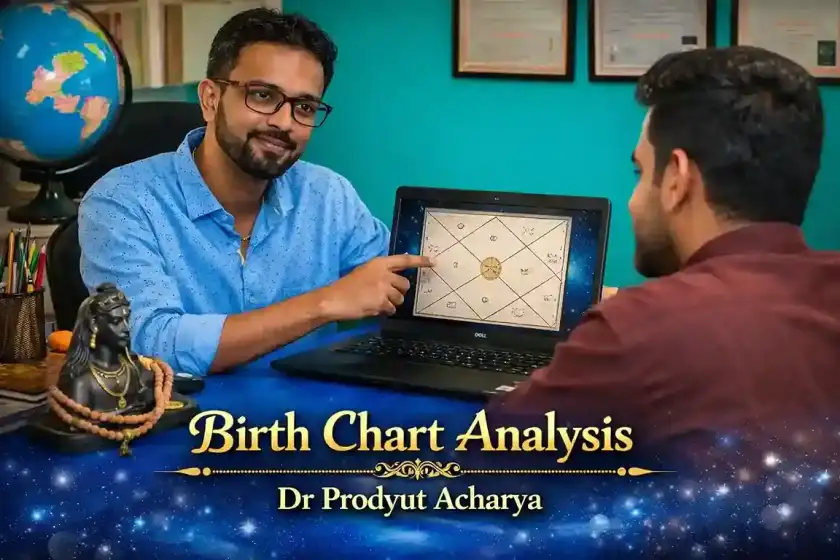
Vedic astrology, palmistry and Kundali analysis with Dr. Prodyut Acharya — online, at a time that suits you · English, Bengali and Hindi

Send photographs of both palms on WhatsApp — a detailed phone analysis follows within 3–4 hours.
- Front and back photos of both hands
- Phone analysis within 3–4 hours
- Remedial guidance based on the lines
- Available in English, Bengali and Hindi
🔒 Razorpay • UPI / Card / Net Banking
Hand analysis and full birth-chart reading together — maximum insight, minimum cost.
- Complete palm analysis with remedies
- 90+ page birth-chart PDF
- PDF delivered on WhatsApp
- Detailed phone discussion — 30 minutes
🔒 Razorpay • UPI / Card / Net Banking

A compatibility reading before marriage is essential for a harmonious married life.
- Kundali comparison of both partners
- Mangal dosha and guna assessment
- 90+ page PDF delivered on WhatsApp
- Remedies for marital harmony
🔒 Razorpay • UPI / Card / Net Banking
⭐ What clients say
10,000+ satisfied clients — from India and abroad
"Dr. Acharya gave me clear direction during the hardest period of my life. The Kundali analysis was so precise it left me stunned."
"He read things from my palm that only I knew. The online consultation was effortless. A genuinely learned person."
"We had our Kundali matching done before marriage — today our married life is peaceful. I would have made a serious mistake without his guidance."
Learn the deeper truth
The fine calculations behind tithi, planetary motion and the Panchang are not mere arithmetic — they are the rhythm of our festivals and our lives. MyAstrology's Dr. Prodyut Acharya offers accurate interpretation grounded in modern astronomy and classical texts. Best astrologer in Ranaghat, West Bengal.
🔒 Secure online payment | Razorpay | UPI • Card • Net Banking
