


Vastu Shastra & Modern LivingPeace, Prosperity and Harmony with Nature — Vastu Science for the Modern Home
MyAstrology, Ranaghat — Expert Vastu consultation by Dr. Prodyut Acharya
Every human life rests on three foundations — food, clothing and shelter. Food sustains the body, clothing protects it, but a home is more than mere shelter: it is a refuge for the mind, the breath and the soul.
I am Prodyut Acharya, astrologer and palmist, and I believe every person works a lifetime and saves with care to fulfil one dream — a beautiful, peaceful and secure house of their own. A place where the family gathers at the end of the day, where morning sunlight lifts the spirit, and where the night sky soothes the heart.
"Only in a home where the forces of nature and the cosmos are in harmony can true peace and prosperity reside." — MyAstrology, Ranaghat
The philosophy of Indian Vastu Shastra is the balanced alignment of the forces of nature — direction, light, airflow, magnetic field — in which Vedic astrology, palmistry and the science of Vastu work together for the physical, mental and spiritual development of the individual. This is not superstition, but a blend of millennia of natural science and empirical observation.
Health
Fewer ailments and steadier well-being
Peace
Domestic friction fades; a calm household emerges
Prosperity
Financial stability and success at work
Respect
Social standing and reputation grow
Education
Children grow in learning and character
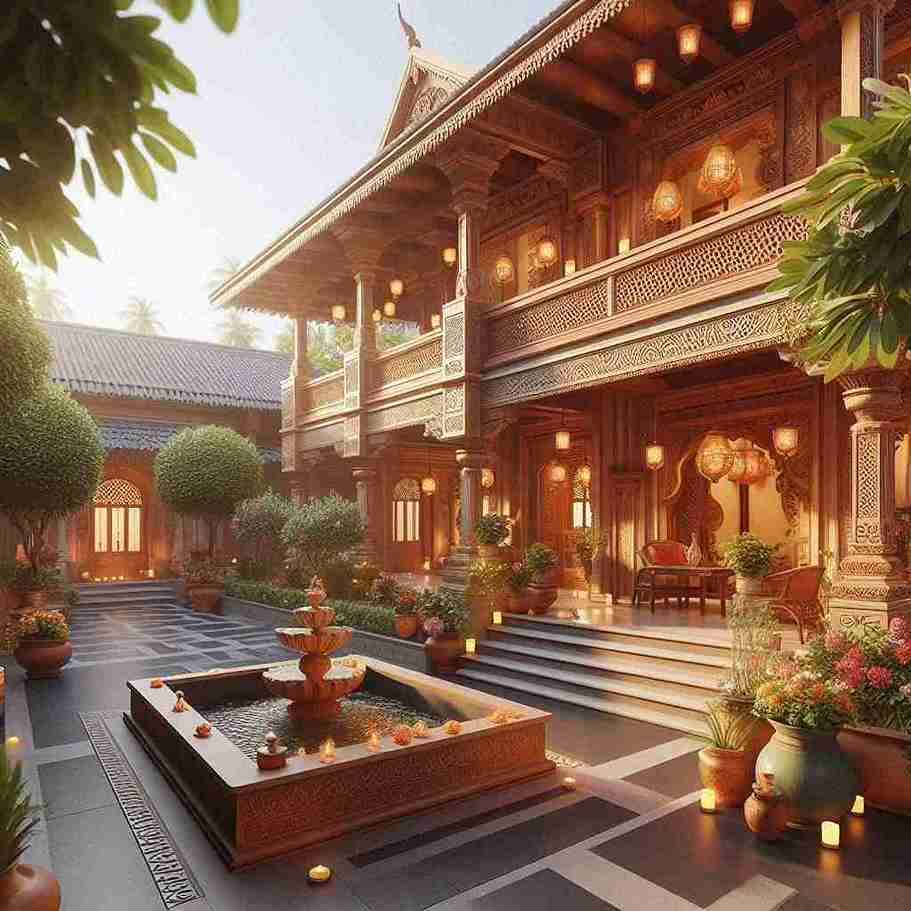
That is why, according to Vedic astrology and Indian Vastu Shastra, building a home — from Ranaghat to Kolkata and across West Bengal — is not merely construction. It is a simultaneous act of science, art and spiritual practice. Nature is our greatest teacher; Vastu Shastra is the blueprint of that teaching.
What is Vastu Shastra?Spiritual and Scientific Foundations of Vedic Architecture
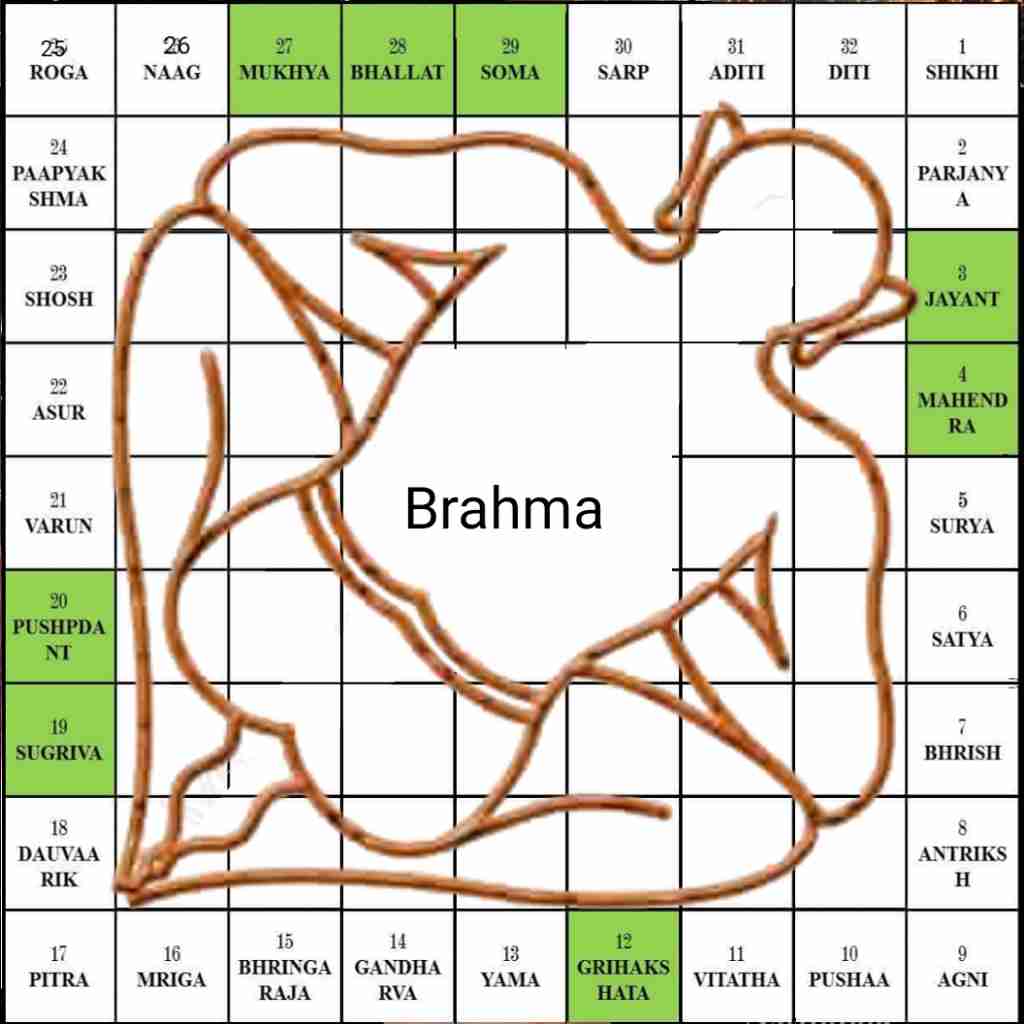
In Sanskrit, "Vastu" means the site where living beings dwell; "Shastra" means the science or governing principle. Vastu Shastra is therefore the ancient Indian science of architecture — its purpose to balance direction, place, material and natural force so that a dwelling promotes peace, health and prosperity. The sages said: "यत् भूमिं च नाभिं च दिशं च विद्याम्" — "He who knows the land, the axis and the direction, prospers."
The Spiritual Foundation
The ancient sages and master builders conceived of the Earth itself as a living being — Vastu Purusha. The balance of the four directions, the sky and the netherworld is the central aim of the Shastra. Each direction is associated with a specific deity: Indra in the East, Kubera in the North, Yama in the South, Varuna in the West.
The Scientific Foundation
- ☀ Sunlight: Morning eastern light is a natural disinfectant and a source of vitamin D.
- 🌬 Airflow: Cross-ventilation reduces humidity and modulates CO₂.
- 🧲 Magnetic field: Sleeping with the head to the south improves circulation.
- 🔥 Thermal control: Thicker walls in the south and west manage heat.
- 🔊 Sound control: Room shape and height support mental calm.
Ancient Vastu Shastra & Modern ArchitectureA Historical and Comparative Analysis
Why have people followed Vastu for millennia?
| Aspect | Vastu Shastra | Modern Architecture |
|---|---|---|
| Direction | Governed by natural light, airflow and the placement of the deities | Governed by site shape, function and aesthetics |
| Material | Natural — stone, earth, timber | Concrete, steel, glass, modern composites |
| Scientific reasoning | Alignment with the Sun, wind and the magnetic field | Comfort, functionality and technology-driven performance |
| Life philosophy | Living in tune with nature | Convenience through technology and mechanics |
Modern architecture prioritises comfort, technology and aesthetic design. But when the scientific components of Vastu Shastra — natural light and ventilation, thermal zoning, correct orientation — are combined with modern design, the result is a dwelling of higher liveability and quality of life.
Why Follow Vastu?A Scriptural and Scientific Perspective
The ancient sages believed that a home is not merely a structure of brick and stone — it is a field of living energy. Built correctly, it brings peace, prosperity and health.
Atharva Veda (Prithvi Sukta / Bhumi Sukta): "शं नो भूमिः शं नो आपः शं नो वनस्पतिः।"
— "May the Earth be auspicious to us; may the waters be auspicious; may the trees be auspicious."
According to classical texts, Vastu brings —
- Health: Proper light and airflow keep disease away.
- Peace: Balanced energy steadies the mind and the household.
- Prosperity: Financial progress and professional success.
- Social standing: A well-oriented home earns respect and repute.
Real-world examples
- Ancient: Mohenjo-daro and Harappa were planned with careful alignment to light and airflow.
- Modern: Infosys and several major corporate campuses have been laid out according to Vastu principles.
- Domestic: Many families report improvement after relocating their main entrance to an auspicious direction.

Plot Direction & Road PositionVastu Guidance on Site Selection
The Mayamata Vastu Shastra and the Vishwakarma Prakash both state: "पूर्वेण वा उत्तरतः प्राप्तो मार्गः शुभदः सदा" — "Where the road lies to the east or the north, there is always auspicious fruit."
Which plot direction is auspicious?
- East-facing plot: The first rays of the Sun enter directly — a symbol of health, knowledge and prosperity.
- North-facing plot: The direction of Kubera — brings financial progress and commercial success.
- West-facing plot: Mixed results — afternoon sun builds heat, but can be profitable for offices or commerce.
- South-facing plot: Traditionally avoided — the texts associate it with accidents, illness and financial loss.
Result according to road position
| Plot facing | Road position | Scriptural result | Scientific reasoning |
|---|---|---|---|
| East | Road to the east | Highly auspicious — health, knowledge, fame | Morning sunlight supports vitamin D synthesis and acts as a natural disinfectant |
| North | Road to the north | Auspicious — wealth and commercial growth | The cool northern breeze and steady light keep the home comfortable |
| West | Road to the west | Mixed — some financial gain, but health issues | Intense afternoon sun heats the home and causes discomfort |
| South | Road to the south | Inauspicious — illness and accidents | Hot winds and dust flow more strongly from this side |
| East | Road at the NE corner | Highly auspicious — spiritual progress and good fortune | The Ishanya corner (NE) is the optimal entry point for light and air |
Special scriptural instructions
- Ishanya (NE) corner — kept open to allow auspicious energy in.
- Nairutya (SW) corner — kept enclosed to preserve stability and wealth.
- Agneya (SE) corner — if it faces a road, take care to avoid fire-related risk.
- Vayavya (NW) corner — a road here can create restlessness in movement.

Monthly Vastu Naga ChartSelecting the Auspicious Month for Construction
Author: Prodyut Acharya — Vedic Astrologer & Palmist | Authentic Astrology & Vastu Science

In Vastu Shastra, the Vastu Naga is the living soul of the plot, whose body is divided into head, tail, back and lap. The position of these four parts is crucial when laying a foundation.
- On the head — construction is inauspicious; this is the Naga's vital centre. ⚠
- On the tail — best avoided; stability is compromised.
- On the back — progress is slow.
- On the lap — the most auspicious position; peace, wealth and lasting happiness follow.
As the Shastra says — "यत्र वक्षः, तत्र भवनं महाशुभम्"
"Where the lap of the Naga lies, there a home of great fortune, peace and lasting joy is built."
Monthly Vastu Naga sleeping-direction and construction guide
| Month (Bengali) | Head direction | Tail direction | Lap direction | Back direction | Auspicious construction side | Entrance facing |
|---|---|---|---|---|---|---|
| Vaishakh | North-East | South-West | South side | North side | East-facing house on the south side of the plot | North-facing |
| Jyaishtha | East | West | South-West portion | North-East portion | North-East open, house to the SW | North-East open |
| Asharh | South-East | North-West | West portion | East portion | East-facing house on the west side of the plot | East-facing |
| Sravana | South | North | North-East portion | South-West portion | South-facing house at the NE | South-facing |
| Bhadra | South-West | North-East | East portion | West portion | West-facing house on the east side | West-facing |
| Ashwin | West | East | North-West portion | South-East portion | South-facing house at the NW | South-facing |
| Kartik | North-West | South-East | South portion | North portion | North-facing house on the south side | North-facing |
| Agrahayan | North | South | South-East portion | North-West portion | West-facing house at the SE | West-facing |
| Paush | North-East | South-West | West portion | East portion | East-facing house on the west side | East-facing |
| Magh | East | West | North-East portion | South-West portion | South-facing house at the NE | South-facing |
| Falgun | South-East | North-West | East portion | West portion | West-facing house on the east side | West-facing |
| Chaitra | South | North | South-West portion | North-East portion | North-facing house at the SW | North-facing |
✅ Worked example:
If construction is undertaken in the month of Vaishakh → the Naga's head lies to the north-east, so building in that corner is inauspicious. Because the lap falls to the south, the house should be built on the south side of the plot, and its entrance should face north. Building this way keeps natural light and airflow balanced and lets auspicious energy flow through the home.
32 Vastu Devatas & Gate DirectionsVastu Purusha Mandala — Scriptural Gate-Result Analysis
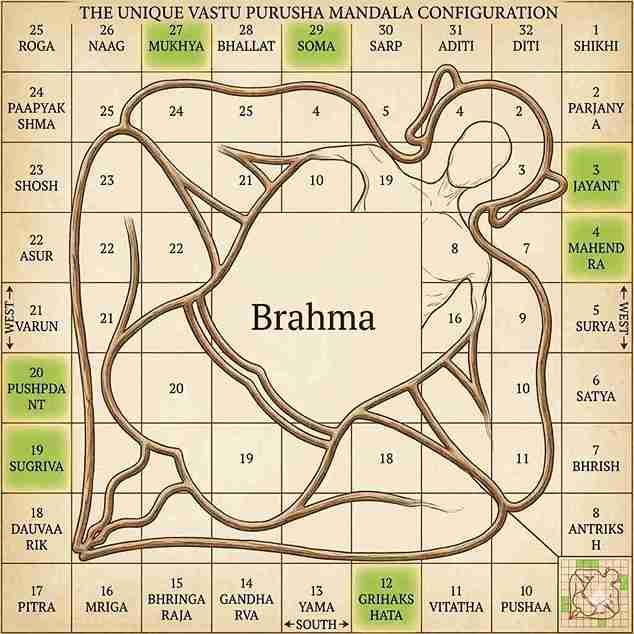
According to the Mayamata Vastu Shastra, the Brihat Samhita and the Vishwakarma Prakash, the Vastu Purusha Mandala hosts 32 devatas. Depending on which devata's zone the main entrance falls in, the household experiences auspicious, inauspicious or mixed results.
Legend
Auspicious — wealth, health, peace | Mixed — neutral | Inauspicious — instability, loss
Sources: Mayamata Vastu Shastra · Brihat Samhita · Vishwakarma Prakash
| No. | Devata | Position | Gate result | Scientific rationale |
|---|---|---|---|---|
| 1 | Shikhi | NE → East | Auspicious — growth of wealth and happiness | Bright morning light reduces pathogens and lifts the mood |
| 2 | Parjanya | East | Auspicious — abundance of rain and harvest | Cool easterly breeze and humidity support water resources |
| 3 | Jayanta | East-central | Highly auspicious — victory and social honour | Morning light builds morale and leadership |
| 4 | Mahendra (Indra) | East-South | Highly auspicious — respect, influence, wealth | A positive entrance increases social visibility |
| 5 | Surya | East-South centre | Mixed — health and energy (excess causes agitation) | Dawn sun is beneficial; excess causes heat and discomfort |
| 6 | Satya | East-North centre | Auspicious — justice, honesty, mental stability | Clear air supports mental clarity and ethical resolve |
| 7 | Bhrisha | SE risk zone | Mixed/inauspicious — restlessness, loss | Excess heat or uncontrolled airflow raises mental tension |
| 8 | Antariksha | East → late South | Inauspicious — financial loss, instability | An uncontrolled entrance can lead to security issues |
| 9 | Agni | South-East | Caution — fire risk, health risk | A kitchen facing a road increases heat and smoke |
| 10 | Pushaa | South-central | Mixed/auspicious — support in wealth and work | A warm environment can increase productivity |
| 11 | Vitatha | South-central risk zone | Inauspicious — deceit, instability | Encourages unplanned activity |
| 12 | Grihakshata | South-central | Inauspicious — domestic discord | Private space exposed at the entrance raises psychological stress |
| 13 | Yama | South centre | Highly inauspicious — illness, serious loss | Excess southern heat can pose health risks |
| 14 | Gandharva | SW → South | Mixed/auspicious — arts, music, success | Creative activity and social contact support mental richness |
| 15 | Bhringaraja | South-West | Auspicious — happiness, social warmth | A stable environment deepens family and spiritual bonds |
| 16 | Mriga | South → SW | Inauspicious/mixed — financial loss | Facing a road increases movement and restlessness |
| 17 | Pitra | West-SW | Inauspicious — paternal relationships suffer | Harsh afternoon sun and dust raise financial stress |
| 18 | Dauvarik | West | Auspicious — honour for the head of the family | Controlled light and humidity encourage social engagement |
| 19 | Sugriva | West-NW | Highly auspicious — courage and business growth | Afternoon light makes a commercial space attractive |
| 20 | Pushpadant | West-central | Highly auspicious — financial stability | Steady light supports saving and financial activity |
| 21 | Varuna | West-North | Auspicious — water resources, social standing | North-west winds help manage water resources |
| 22 | Asur | West-NW | Inauspicious — enmity, legal trouble | Mismatched airflow raises security and social tension |
| 23 | Shosh | North-West | Inauspicious — dryness, weakness | Dry air and low humidity hurt health and drive |
| 24 | Paapyakshma | NW → North | Inauspicious — serious illness, moral risk | An uncontrolled entrance increases safety and health risks |
| 25 | Roga | North | Inauspicious — disease, weakness | Cold, damp northern exposure can encourage bacterial growth |
| 26 | Naag | North-NE | Inauspicious — anxiety, enmity | Unmanaged energy entry raises security anxiety |
| 27 | Mukhya | North-central | Highly auspicious — leadership, success, wealth | Cool northern breeze and balanced light support growth |
| 28 | Bhallat | North-NW | Highly auspicious — commercial success and prosperity | Balanced temperature and airflow stabilise commerce |
| 29 | Soma | North-East | Auspicious — peace, spiritual growth, health | The soft light and cool air of the NE corner favour meditation and well-being |
| 30 | Sarp (Bhujang) | NE edge | Inauspicious — anxiety, enmity, health issues | Uncontrolled humidity and shade create protective concerns |
| 31 | Aditi | North-NE | Auspicious — abundance, happiness of children | An open path to the NNE brings balanced water and light |
| 32 | Diti | North end | Inauspicious — discord, scarcity | Poor light and humidity foster mental unrest and financial strain |
Vastu Room Design — Scriptural and ScientificRoom Placement per the Mayamata, Brihat Samhita and Vishwakarma Prakash
References: Mayamata Vastu Shastra · Brihat Samhita · Vishwakarma Prakash
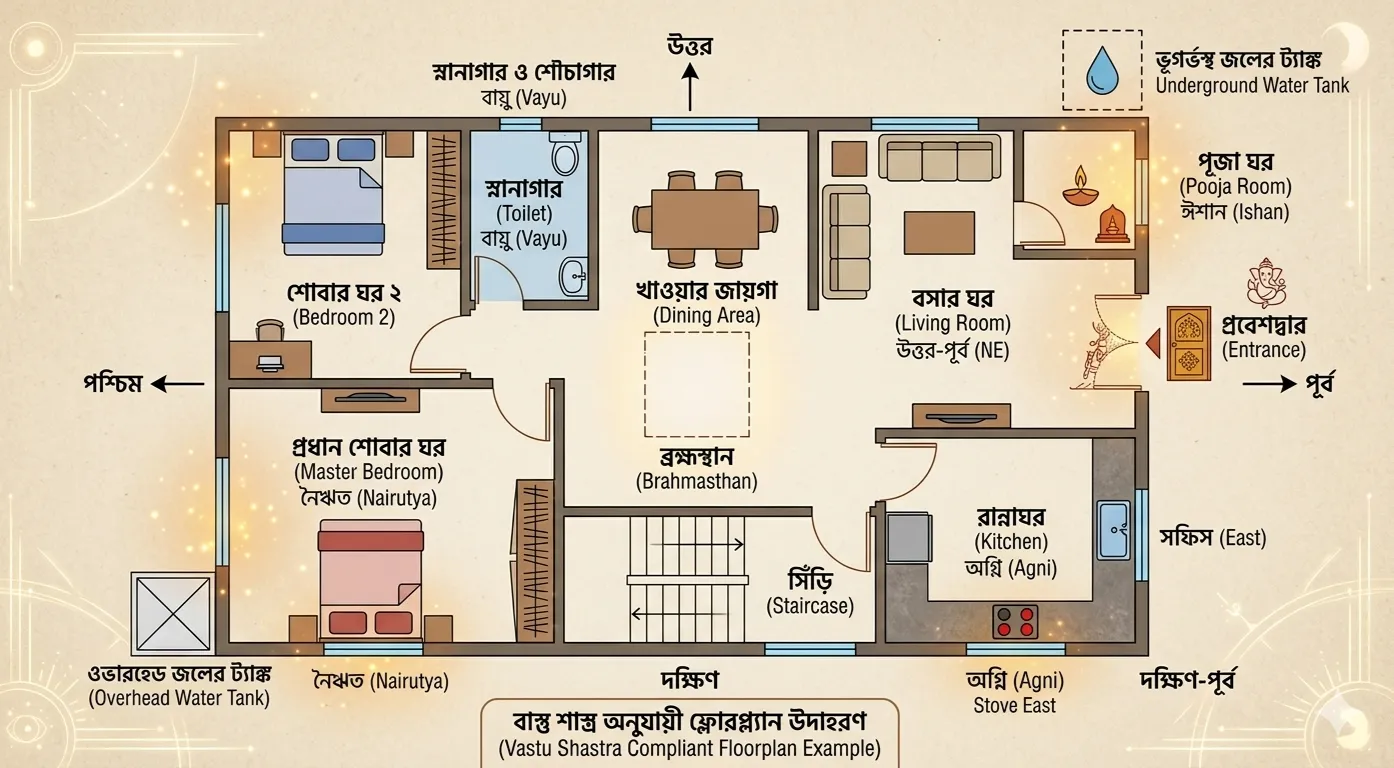
According to Vastu Shastra, room layout is not merely religious belief — it is a science of light, air, temperature and natural forces. Below, each room is listed with its correct direction, scriptural reason and scientific explanation.
1. Bedroom — South-West (SW)
- Scriptural: The Brihat Samhita describes the SW as pure, stable and protective.
- Scientific: Afternoon heat keeps the room warm, and low airflow makes sleep comfortable.
2. Kitchen — South-East (SE)
- Scriptural: Agni, the fire deity, resides in the SE; cooking here increases prosperity.
- Scientific: Morning light dries the kitchen and keeps it free of pathogens.
3. Puja room — North-East (NE)
- Scriptural: The Ishanya corner is the seat of the devatas and supports mental peace.
- Scientific: Morning light is a natural disinfectant, and cool air is ideal for meditation.
4. Bathroom / Toilet — WNW or SSE
- Scriptural: Placing impure functions here does not disrupt the main Vastu energies.
- Scientific: Good ventilation rapidly clears humidity and odour.
5. Staircase — South-West / South / West
- Scriptural: Heavy structural mass to the south or west provides stability.
- Scientific: The north and east sides remain open, improving light and airflow.
Vastu Shastra — Philosophy and SpiritualityCosmic Harmony & Human Life in Vedic Thought
Vastu Shastra is not merely a science of architecture; it is the melding of cosmic forces with the spiritual life of the individual. In ancient Indian philosophy, every place and every direction is a centre of living energy, forming a bridge between body and consciousness.
"वासुदेव कुटुम्बकम्" — "The whole cosmos is one family." Vastu Shastra grows from this thought: the five great elements — earth, water, fire, air and space — are arranged in harmony to build a home.
Through the subtle knowledge of Jyotish, the cosmic motion of time, place and direction improves the quality of human life. When a home is built in harmony with nature and the cosmos, it becomes more than a structure — it becomes a sacred temple where the soul is refined and evolved.
The principles of Vastu Shastra are not superstition; they are the union of centuries of knowledge, observation and natural science. A healthy body, a peaceful mind and a prosperous life are the fruit of Vastu properly applied.
Conclusion
Vastu Shastra gives a person not only a comfortable house, but a spiritual sanctuary in which nature and the human soul connect deeply. Respecting nature's highest force and choosing the right direction and placement paves the path to genuine peace and prosperity. At MyAstrology, this ancient science remains an indispensable guide for modern life.
Vastu vs Feng ShuiTwo Ancient Traditions — One Goal of Harmony
Readers in the West often ask whether Vastu Shastra and Feng Shui are the same thing. They are not. Both traditions emerged independently, several thousand years ago, on opposite sides of Asia — and they solve a similar problem in very different ways.
Vastu Shastra is the Indian science of architecture, first compiled in texts such as the Mayamata, the Brihat Samhita and the Vishwakarma Prakash. Feng Shui is the Chinese tradition of geomancy, systematised in the Zangshu and later commentaries. Neither tradition is a copy of the other. Both arose where they arose, out of local climate, culture and cosmology.
The core difference — compass vs flow
Vastu is fundamentally compass-based. Every rule begins with a direction — the eight cardinal and ordinal directions plus the subtle intermediate zones of the Vastu Purusha Mandala. The classical texts are emphatic: the correct direction of a room determines its function. Sleeping with the head to the south, cooking in the south-east, entering from the north or east — these are the anchors of Vastu.
Feng Shui, by contrast, is fundamentally flow-based. Its central concept is qi — a subtle life-force that moves through a space. The practitioner's task is to make sure qi does not stagnate, does not rush, and does not clash with the resident's own energy. Direction matters, but only as one factor among many.
Comparative table
| Aspect | Vastu Shastra | Feng Shui |
|---|---|---|
| Origin | Indian subcontinent, ~3000 BCE or earlier | China, ~2000 BCE or earlier |
| Primary source texts | Mayamata, Brihat Samhita, Vishwakarma Prakash, Samarangana Sutradhara | Zangshu, Qing Nang Jing, later commentaries |
| Metaphysical base | Five elements (pancha-bhuta) and 32 devatas of the Vastu Purusha Mandala | Yin-Yang, the five phases (wu xing), and qi flow |
| Core principle | Correct alignment of direction with function | Free, harmonious flow of qi through space |
| Compass role | Central — every rule is direction-keyed | One tool among several |
| Room placement | Fixed by classical prescription | Adjusted by resident, timing and layout |
| Remedies | Structural adjustment, yantra, colour, plant | Mirror, crystal, water feature, plant |
| Modern outreach | Common across India and the Indian diaspora | Common across East Asia and the West |
What they agree on
Despite their different metaphysics, Vastu and Feng Shui converge on a striking number of practical recommendations:
- Keep the main entrance clean, unobstructed and well-lit.
- Place the sleeping head away from the direction of strongest magnetic flux.
- Keep heavy structural mass away from the direction of strongest sunlight.
- Maintain clear air circulation between rooms.
- Locate the kitchen in a position where heat and odour do not enter the whole house.
- Keep the north-east (or its equivalent) open and uncluttered.
Whether these practices are called Vastu or Feng Shui, they converge on the same underlying intuition: a home should not fight the landscape, the climate or the bodies that live inside it.
Which should you use?
If you are building or renovating in India — or in the Indian diaspora, where directions are already familiar — Vastu is the natural system. It is integrated with the Indian calendar, the Panchang and the wider Jyotish tradition. At MyAstrology, every recommendation is Vastu-based, cross-checked against the classical texts and computed for the exact coordinates of your plot.
If, however, you find that a Feng Shui consultant's recommendations also work for you, there is no conflict. Several households in Bengal and across India practise both in parallel — Vastu for structure and direction, Feng Shui for interior flow.
The Scientific Case for VastuWhat Modern Research Says About Vedic Architecture
Vastu Shastra is a traditional knowledge system. It is not a laboratory science, and it does not claim to be one. Yet a careful reading reveals that a large number of its prescriptions are consistent with findings that modern architecture, environmental psychology and building physics have arrived at independently.
Below, we examine the most significant of those convergences — not as proof that Vastu is a modern science, but as evidence that its authors were careful empirical observers of the built environment.
1. Solar orientation and circadian health
Vastu places the main entrance and the living spaces toward the east. The reason given is that the first rays of the morning Sun carry prana. Modern medicine gives a parallel reason: exposure to morning light within an hour of waking stabilises the circadian rhythm, improves sleep quality and reduces symptoms of seasonal affective disorder.
The classical Vastu prescription for an east-facing entry is therefore not merely symbolic. It produces a household whose occupants are biologically synchronised with the day.
2. Cross-ventilation and microbial load
Vastu requires openings on at least two opposite sides of a room — typically east-north or south-north. The classical reason is that the flow of air carries away dosha. Modern building science quantifies the same effect: cross-ventilation reduces humidity, dilutes airborne pathogens and lowers CO₂ concentration, all of which have measurable effects on respiratory health.
3. Thermal zoning
Vastu prescribes heavy walls on the south and west, and openings on the north and east. This rule matches the principle of thermal zoning in passive-solar design: the walls facing the strongest solar load are built thickest and with least glazing, while those facing the coolest directions carry the larger windows.
Studies of traditional buildings in the Indian subcontinent have shown that this arrangement alone reduces cooling loads by 15–25% compared to a conventionally oriented building.
4. Geomagnetic alignment during sleep
The classical Vastu rule for sleeping with the head to the south corresponds with the direction of Earth's magnetic field lines (from north to south). While the physiological effect of geomagnetic orientation on sleep is still debated, several studies have noted measurable differences in EEG patterns, blood pressure and melatonin secretion depending on sleeping orientation.
Vastu's recommendation is at minimum consistent with the possibility that human biology is subtly affected by the geomagnetic field.
5. Sacred geometry and cognitive ease
The Vastu Purusha Mandala is a fractal grid — a nested series of 8, 9, 64 or 81 divisions that underlies every classical building. Modern cognitive research shows that spaces built according to a coherent geometric grid are judged by occupants as calmer and more spacious than geometrically arbitrary spaces of the same physical size. The grid is not decoration; it is a cognitive aid.
What this does and does not prove
None of the above proves that Vastu Shastra captures a hidden physics of the cosmos. What it does show is that the tradition's core recommendations are not arbitrary. They are the accumulated output of generations of careful observers, and — where they can be tested — they tend to converge with what modern design science independently discovered.
For the practising consultant, this is enough. Vastu does not need to be proven a science in order to be useful. It only needs to work — and the experience of thousands of families across India, over thousands of years, suggests that it does.
How to Read a Vastu ChartA Practical Guide for First-Time Clients
When you receive a Vastu report from a consultant, you are usually given a chart — a square grid divided into zones, overlaid on a plan of your plot or house. If you have never seen one before, it can look more complex than it is. Here is how to read it, step by step.
Step 1 — Find north
Every Vastu chart is drawn with north at the top (or, occasionally, at the bottom — but always clearly labelled). Before reading anything else, confirm which way is north. A chart without a clear north indicator is unusable.
Step 2 — Locate the nine zones
The chart is divided into nine zones: the four cardinal directions (N, E, S, W), the four ordinal corners (NE, SE, SW, NW), and a central zone called the Brahmasthan.
- NE (Ishanya) — the most sacred zone. Best for prayer, water and openness.
- SE (Agneya) — the zone of Agni. Best for the kitchen and electrical systems.
- SW (Nairutya) — the zone of stability. Best for the master bedroom and heavy storage.
- NW (Vayavya) — the zone of movement. Best for guest rooms, bathrooms and outgoing activity.
- Centre (Brahmasthan) — kept open and free of heavy structure.
Step 3 — Identify the entrance
On your chart, the main door is marked. Its direction determines the initial reading. A north-east entrance is considered the best; a south-west entrance is generally avoided; the intermediate directions (north-north-west, east-south-east, etc.) require careful judgment using the 32-devata table.
Step 4 — Place your rooms
Overlay your actual room layout onto the chart. For each room — kitchen, bedroom, bathroom, puja room, storage — check which zone it falls into. The zones are usually colour-coded:
- Green — auspicious; the room's function matches the zone.
- Yellow — neutral; no significant effect either way.
- Red — inauspicious; the room is in a zone reserved for a different function.
Step 5 — Read the proposed remedies
Any zone that falls into the red is given a remedy. Remedies in Vastu are of five kinds:
- Structural — moving a wall, adding a partition or shifting a door.
- Elemental — placing a specific material (metal, stone, wood, water) in the zone.
- Colour — painting a wall a specific shade to shift the zone's energetic quality.
- Botanical — planting a specific tree or shrub on the outer perimeter.
- Yantric — installing a sacred diagram (yantra) at a prescribed point.
A well-made report will also tell you which remedies are essential and which are optional. If your consultant does not say so, ask. A good consultant never charges you for a remedy you do not need.
Step 6 — Ask three questions
Before accepting any Vastu report, ask the following:
- What source are you working from? The answer should be a named classical text — Mayamata, Brihat Samhita, Vishwakarma Prakash, Samarangana Sutradhara — not "tradition says".
- Which remedies are mandatory and which are optional? If everything is mandatory, that is a red flag.
- Are you selling anything? A good Vastu consultant does not sell yantras, amulets or gemstones. Their fee is for analysis and advice, nothing else.
At MyAstrology, every Vastu report is documented with the source text for each recommendation, with the mandatory and optional remedies clearly separated, and with no commercial product attached.