

🌐 Read this in: हिन्दी · বাংলা
“Jyoti means light. The shastra that gives light and revelation to life is called Jyotisha Shastra. This vidya is called the Eye of the Vedas.”
Many people understand Jyotisha as merely fortune-telling. But when we look at the root meaning of the word, its place in the Vedas, and its thousand-year history, we understand — it is the shastra of measuring time by the light of the sky, and the vidya of guiding life's path through the knowledge of that time. This article covers, with citations from the primary texts, the meaning of the word, the Vedangas, where astrology was born, the three skandhas, and the logic of karma and destiny.
Meaning and Origin of the Word Jyotisha
Jyotisha
The word Jyotisha comes from the Sanskrit ‘Jyotih’ (Jyotis). ‘Jyotih’ means light, radiance — and those in the sky who give light: the Sun, Moon, planets, stars, that is, jyotishka. Therefore Jyotisha means knowledge of the luminaries.
In the Paniniya Shiksha, the name of this vidya is even clearer — ‘Jyotisham Ayanam’, meaning the path of the luminaries. Which path the lights of the sky follow, where they remain at what time — this calculation is the foundation of Jyotisha. And from that calculation comes its application: showing light on the path of life.
Astrology
The English word ‘Astrology’ comes from Greek astrologia — - Astron = star - -logia (from Logos) = study, discourse
Therefore Astrology = star-study or the study of the stars.
Hora
The shastra of reading the birth chart is called Horashastra. Varahamihira explains this at the very beginning of Brihat Jataka (1.3):
Horetyahoratravikalpameke vanchanti purvaparavarnalopat.
That is — from the word ‘Ahoratra’ (day and night), dropping the first and last letters (‘A’ and ‘tra’), what remains is ‘Hora’ — such is the opinion of many. Therefore Horashastra is really the Science of Time: the moment of the day or night of birth is the very foundation of the chart.
The Eye of the Vedas — Vedanga Jyotisha
In Indian tradition, Jyotisha is a limb of the Vedas itself — one of the six auxiliary sciences (Vedangas) required for reading the Vedas and performing Vedic yajnas correctly. The Paniniya Shiksha describes each Vedanga as a limb of the Veda-Purusha:
| Order | Vedanga | Subject | Limb of Veda-Purusha |
|---|---|---|---|
| 1 | Shiksha | Pronunciation, phonetics | Nose |
| 2 | Kalpa | Yajna, rituals and ceremonies | Hands |
| 3 | Vyakarana | Grammar of language, purity of words | Mouth |
| 4 | Nirukta | Etymology, meaning of words | Ears |
| 5 | Chhanda | Metre and measure of mantras | Feet |
| 6 | Jyotisha | Planets and stars, time, calculation of time | Eyes |
Chhandah padau tu vedasya hastau kalpo’tha pathyate.
Jyotishamayanam chakshurniruktam shrotramuchyate.
Shiksha ghranam tu vedasya mukham vyakaranam smritam.
— Paniniya Shiksha, 41–42
Therefore Jyotisha is called the Eye of the Vedas (Vedasya Chakshu). Just as the eye shows the path, Jyotisha shows when — in which season, on which tithi and nakshatra, which yajna should be performed. Sage Lagadha’s Vedanga Jyotisha introduces itself thus:
Tasmadidam kalavidhanashastram yo jyotisham veda sa veda yajnan.
That is — this is Kalavidhanashastra, the shastra of determining time; one who knows Jyotisha knows the yajnas.
The primary subject of Vedanga Jyotisha is therefore time calculation — nakshatras, seasons, ayana, the five-year yuga. The full form of Horashastra for reading the birth chart comes later, in the texts of Parashara and Varahamihira.
In Which Country Was Astrology Born?
The honest answer to this question is — the attempt to understand time and auspicious or inauspicious conditions by observing the sky existed in almost every ancient civilization: Mesopotamia (Babylon), Egypt, Greece, China — each with its own stream. The special feature of India’s stream is its continuity: from Vedanga Jyotisha to Aryabhata (late fifth century), Varahamihira (sixth century), and down to today’s Bengali panjika, this vidya has continued without interruption.
Indian astrologers did not disrespect the knowledge of other countries. Varahamihira himself wrote in Brihat Samhita (2.15) — if Yavana (Greek) astrologers know this shastra well, they are honoured like sages; then who would not honour a shastra-knowing Brahmin astrologer?
The Three Skandhas of Jyotisha Shastra
Nowadays Jyotisha is generally described as two-fold — mathematical and applied. Varahamihira, at the beginning of Brihat Samhita (1.9), divided the shastra into three skandhas:
1. Siddhanta or Mathematical Astrology (Astronomy)
The vidya by which the motion, position, and character of stars and planets in space are known is called Mathematical Astrology or Astronomy.
- Determining planetary motion
- Times of solar and lunar eclipses
- Preparing the panjika
- Determining seasons, months, and tithis
2. Hora or Nativity
Judging life from the planetary positions at the moment of birth — in his Hora work Varahamihira treated nativity, journeys and marriage (Brihat Samhita 1.10).
- Birth chart analysis
- Results of dasha and antardasha
- Marriage matching, auspicious times for travel and work
- Health tendencies and remedies — alongside medical treatment
3. Samhita
Auspicious and inauspicious matters concerning country, society, and nature — rain and crops, earthquakes, vastu, gems, omens. Brihat Samhita is a text of this skandha.
Mathematical and Applied — Where Is the Difference?
| Subject | Mathematical Astrology | Applied Astrology |
|---|---|---|
| Skandha | Siddhanta | Hora and Samhita |
| Question | Where are the planets, when will they go where | What does that position indicate in life |
| Result | Numbers — tithi, nakshatra, planetary longitude, eclipse times | Tendencies of happiness and sorrow, and auspicious timing |
| Verification | Can be matched by measuring the sky | Depends on the astrologer’s shastra-knowledge and judgment |
Mathematical astrology can still be measured and verified — our panjika and the planetary longitudes in a chart are matched against modern astronomical calculations. Applied astrology is the shastra of the sages’ long observation and experience — therefore the basis of applied judgment is accurate mathematics.
Solar System and Astrology — Why Rahu-Ketu Are Shadow Planets
Our Milky Way Galaxy is made of hundreds of billions of stars. Many stars are far larger than the Sun. The Sun is one of them — and around the Sun is the Solar System:
- The Sun is at the centre
- Around the Sun constantly revolve Mercury, Venus, Earth, Mars, Jupiter, Saturn (distant Uranus and Neptune are not considered in traditional astrology)
- The Moon is Earth’s satellite — it revolves around Earth
- Rahu and Ketu are not objects — they are the two intersection points where the Moon’s orbit cuts the Sun’s apparent path (the ecliptic). Therefore they are shadow planets; when the Sun is near these points, an eclipse occurs on the new moon or full moon
Astrology looks at the sky from Earth. Therefore the Sun and Moon are also ‘planets’ in astrology — the Navagraha: Ravi, Chandra, Mangala, Budha, Brihaspati, Shukra, Shani, Rahu, Ketu. And the 27 nakshatras are stars far outside the solar system — they are the backdrop against which the positions of the planets are measured.
The positions of the planets, their mutual aspects, wars, exaltation and debilitation, friend-enemy moods — with all these the astrologer judges the flow of events in human life.
Synthesis of Knowledge — The Multidimensionality of Astrology
With the help of astrology, several other disciplines grew in India, and astrology also borrowed from them:
| Subject | Relationship with Astrology |
|---|---|
| ➗ Mathematics | While calculating planetary positions came trigonometry and sine tables. Aryabhata’s ‘jya’ became ‘jiba’ in Arabic and ‘sinus’ in Latin — the origin of today’s sine |
| 🔭 Astronomy | Motion of planets and stars, rising and setting, calculation of solar and lunar eclipses |
| 📅 Panjika and Religious Practice | Tithi, nakshatra, sankranti — days and times of vows and festivals |
| 🌾 Agriculture and Weather | Separate chapters in Brihat Samhita on rain prediction and crops |
| 🏠 Vastu and Architecture | Chapters in Brihat Samhita on house construction — direction, measurement, Vastu Purusha |
| 💎 Gemology | Chapters in Brihat Samhita on testing diamonds, rubies, and other gems |
| 🧠 Psychology | Judgment of temperament and mental tendencies according to planets |
| 📜 Philosophy | Karma, destiny, liberation — the meaning of life |
Jyotisha does not merely calculate fortune — it is a method of understanding life’s questions.
Why Astrology Is Needed — Application in Life
Astrologers analyse and try to help people become healthy and happy in various ways.
| Subject | Role of Astrology |
|---|---|
| 💍 Marriage | Chart matching, guna matching, auspicious time of marriage |
| 👶 Children | Future of the child, naming ceremony, and auspicious time for annaprashana |
| 💼 Business | Auspicious time for business, selection of partners |
| 👔 Job | Workplace, time of promotion |
| ✈️ Travel | Determining the moment, direction |
| 🏠 Building Construction | Ground worship, time of housewarming |
| 💰 Wealth | Sources of income, time of investment |
| 🩺 Health | Which direction to be careful in — treatment always under a doctor’s advice |
People need astrology in life because it:
- Guides life’s path — which path offers greater possibility of success
- Shows the importance of time — what should be done when
- Harmonises karma and destiny — shows the path of action instead of waiting for destiny
- Increases self-confidence — helps make the right decision at the right time
- Gives mental peace — explains why something is not happening and reassures
However, an astrologer must be chosen carefully. Varahamihira says in Brihat Samhita (2.16–17) — an ‘astrologer’ who has picked up the subject by hearsay, without studying the shastra, should not be consulted.
Karma and Destiny — The Philosophy of Astrology
The philosophical foundation of Jyotisha Shastra is — the harmony of karma and destiny.
In the verse of Brihat Jataka that explains the word ‘Hora’, the second half says — Horashastra reveals in what order the results of good and bad karma acquired in previous births will come. That is, astrology does not create destiny — it shows the picture of karma.
Karmanyevadhikaraste ma phaleshu kadachana.
Ma karmaphalaheturbhurma te sango’stvakarmani.
— Shrimad Bhagavad Gita, 2.47
That is — “You have a right to action alone, never to its fruits. Let not the fruits be your motive, nor let your attachment be to inaction.”
Reading the two together makes the argument clear: the results of old karma are seen in the chart, but our right over this birth’s karma is complete. Therefore, sitting idle after seeing the chart is wrong, and being restless for results is equally wrong. Astrology shows at which time and in which direction effort will yield more — the effort itself is ours.
Astrology does not merely predict the future — it helps shape the future.
Astrology, Palmistry, and Psychology
Palmistry — A Complementary Science
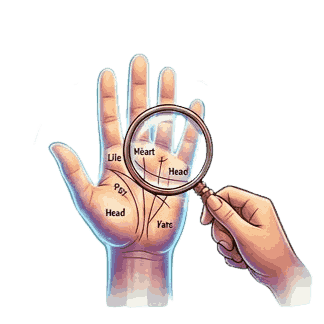
Just as astrology shows the energies of the planets, Palmistry sees their practical reflection in the lines of the hand.
| Astrology | Palmistry |
|---|---|
| Planetary positions in the birth chart | Structure, length, and depth of hand lines |
| Dasha and antardasha | Changes in lines, islands, chains |
| Auspicious and inauspicious results of planets | Saturn line, Sun line, Mars line |
| Marriage prospects | Marriage line, mount of Venus |
| Financial prospects | Wealth line, mount of Jupiter |
When the two are studied together, the indication of one can be verified through the other, making the judgment more reliable.
Psychology — Planets and Personality
Modern psychology sees personality as a mixture of innate tendencies and environmental experience — a human being is not a blank slate at birth, nor is everything fixed at birth. Astrology reads those tendencies from the planetary positions at the moment of birth. In both views, tendency is not fate — it changes through habit and action.
| Planet | Tendencies of Temperament |
|---|---|
| ☀️ Sun | Leadership, self-confidence, authority |
| 🌙 Moon | Emotional, compassionate, changeable |
| 🔴 Mars | Energetic, competitive, aggressive |
| ☿ Mercury | Intelligent, communicative, analytical |
| ♃ Jupiter | Optimistic, teacher, philosophical |
| ♀ Venus | Artistic, relationship-oriented, pleasure-loving |
| ♄ Saturn | Disciplined, patient, serious |
| ☊ Rahu | Technology-loving, foreign-oriented, unconventional |
| ☋ Ketu | Spiritual, detached, researcher |
Conclusion
Jyotisha Shastra is the Eye of the Vedas — it gives light on the path of life. Its origin lies in the rigorous sadhana and observation of the ancient Indian sages — from the time-calculation of Vedanga Jyotisha to the mathematics of Aryabhata and the three skandhas of Varahamihira. It is not merely the vidya of fortune-telling — it has a deep connection with mathematics, astronomy, the panjika, vastu, psychology, and philosophy.
Palmistry works as a complement to astrology. Psychology helps us understand the planetary analysis of astrology in modern language. Philosophy builds a bridge between karma and destiny. In every field of life — marriage, children, business, job, travel, building construction — Jyotisha Shastra shows the right path; walking that path is our karma.
“Jyoti means light. The shastra that gives light to life — that is called Jyotisha.”
❓ Frequently Asked Questions (FAQ)
Question 1: What is the meaning of the word Jyotisha?
Answer: The Sanskrit ‘Jyotih’ means light, radiance — the luminous luminaries of the sky. Jyotisha means knowledge of the luminaries; in the Paniniya Shiksha it is called ‘Jyotisham Ayanam’ — the path of the luminaries.
Question 2: Why is Jyotisha called the Eye of the Vedas?
Answer: Paniniya Shiksha (41–42) describes the six Vedangas as limbs of the Veda-Purusha — Chhanda as the feet, Kalpa as the hands, Jyotisha as the eyes, Nirukta as the ears, Shiksha as the nose, and Vyakarana as the mouth. Just as the eye shows the path, Jyotisha shows at what time which yajna should be performed — therefore Vedanga Jyotisha calls itself ‘Kalavidhanashastra’.
Question 3: In which country was astrology born?
Answer: The tradition of understanding time and auspicious or inauspicious conditions by observing the sky existed in almost all ancient civilizations — Babylon, Egypt, Greece, China, and India. The special feature of India’s stream is its continuity — from Vedanga Jyotisha to Aryabhata and Varahamihira, and down to today’s panjika.
Question 4: What is the meaning of the word ‘Hora’?
Answer: Varahamihira says in Brihat Jataka (1.3) — by dropping the first and last letters of ‘Ahoratra’ (day and night), ‘Hora’ remains. Therefore Horashastra means judging life on the basis of the time of the birth moment.
Question 5: What are the three skandhas of Jyotisha?
Answer: According to Brihat Samhita (1.9) — Siddhanta or Ganita (motion and position of planets), Hora or Jataka (the native’s birth chart), and Samhita (country, nature, rain, vastu, omens).
Question 6: Are Rahu and Ketu really planets?
Answer: Rahu and Ketu are not objects — they are the two intersection points of the Moon’s orbit and the Sun’s apparent path. Therefore in astrology they are ‘shadow planets’. Eclipses occur near these two points, so the names of Rahu and Ketu are associated with eclipses.
Question 7: What is Prashna astrology? If the birth time is not known, can astrology still help?
Answer: Yes. If the birth time is unknown, or if an answer to a specific question is sought, a chart is cast for the moment of asking the question and judged — this is called Prashna astrology. It also stands on time, like Horashastra; only instead of the birth moment, it uses the moment of the question. On our site, you can ask a question free of charge.
Question 8: Can astrology change destiny?
Answer: Brihat Jataka (1.3) says that Horashastra shows the order of the results of karma from previous births — it does not create destiny. The Gita (2.47) says that we have full right over this birth’s karma. Therefore astrology shows at which time and in which direction effort will yield more; it is our karma that changes.
📚 Sources: Paniniya Shiksha, verses 41–42 (the body-metaphor of the Vedangas); Sage Lagadha, Vedanga Jyotisha (“Kalavidhanashastra”); Varahamihira, Brihat Samhita 1.9–10, 2.15–17 (English translation by N. Chidambaram Iyer); Varahamihira, Brihat Jataka 1.3; Aryabhata, Aryabhatiya (sine table); Shrimad Bhagavad Gita 2.47.
🔗 Read more: Does Everyone Have Good Fortune? Power, Karma & Application Explained · Without Conquering the Mind, Success Is Impossible — The Logic of Psychology and Astrology (in Bengali) · Palmistry: The Map of Life — The Relationship Between Astrology and Palmistry (in Bengali)



 PalmistryFrom ₹1,001
 Janam KundaliFrom ₹1,501
 Marriage MatchingFrom ₹2,001
 GemstonesConsultation
 Vastu ShastraConsultation
 NumerologyConsultation
 Prashna JyotishConsultation
 PanjikaBengali calendar